What Is A Merchant Of Record: How Does MoR Cut eCommerce Risk?

What Is a Merchant of Record?
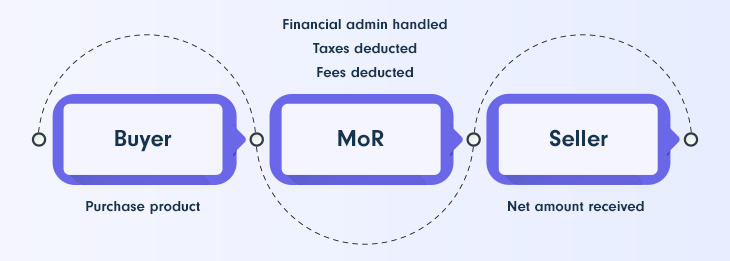
An MoR is a legal entity or organization that acts as a reseller between two parties in an eCommerce transaction. The MoR takes responsibility for reselling its vendor’s products to their customers around the world, all the while providing you with the tools needed to manage your overall business operations.
What is a Merchant Of Record Responsible For?
The MoR is responsible for the entire customer interaction, from the moment the buyer initiates the purchase process until the customer receives their product. Even then, the MoR is still working away in the background throughout the entire customer lifecycle, taking responsibility for subscription management, support, reconciliation, managing refunds, and chargebacks, maintaining international tax compliance, and taking care of currency conversion.
The MoR is also responsible for ensuring compliance with the Payment Card Industry Data Security Standards (PCI DSS), data privacy regulations, and other rules and regulations specific to the countries and regions they operate in.
The MoR is essentially the seller of the product, taking care of all the complex responsibilities that come with it. This means there’s no need to assume financial liability or maintain banking relationships, merchant accounts, and payment gateways.
How the Merchant of Record Model Works (In 5 Steps)
Does My Business Require a Merchant of Record Services?
One of the main benefits SaaS businesses with global reach gain when working with an MoR is the all-inclusive nature of the model. Besides vendor & shopper support, marketing tools, CRM & BI capabilities, lead management, and a large number of languages, currencies, and payment methods, the MoR also takes care of all financial, legal, and administrative work, including payments, billing, taxes, and compliance.
SaaS and Software companies that sell locally may be able to act as their own seller or MoR as it’s more feasible to manage transactions within your own country. However, working with an MoR solution is still beneficial as even local taxes can get complicated. Case in point, look at the 14,000 + tax jurisdictions in the U.S.
The Top 7 Risks Facing eCommerce Businesses
Like many other businesses, eCommerce providers face various risks that can affect growth and damage customer trust.
So what is the best way to minimize or even remove these eCommerce risks? Work with a Merchant of Record eCommerce solution with a track record for success.
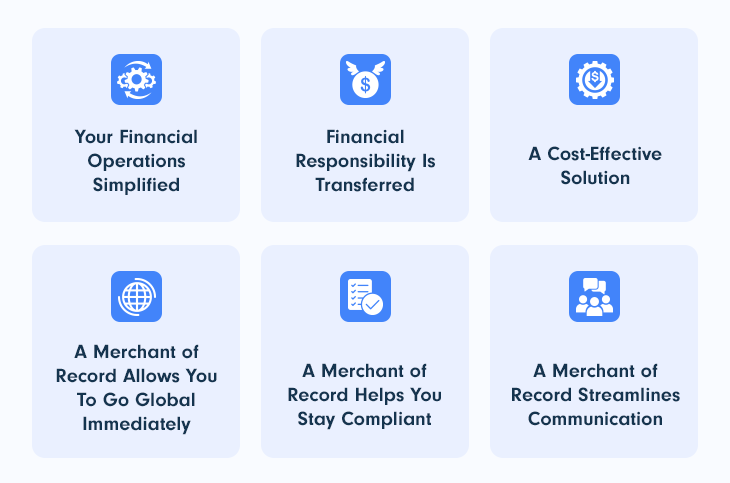
How an MoR Model Reduces eCommerce Risk (6 Benefits for SaaS Businesses)
1. Your Financial Operations Simplified
Managing your eCommerce business becomes incredibly complex when selling online to customers all over the country, increasing as you grow your business globally. These financial operations are simplified significantly for SaaS businesses that partner with an MoR.
So let’s take a closer look at what’s involved:
Merchant Accounts and Payment Gateways
If you don’t use a Merchant of Record model to manage your eCommerce business, you’ll have to set up more than one merchant account in every country in which you have customers. This is so you can accept payments in other currencies, which is critical for localization services. An MoR solution will already have these connections in place, ready to instantly deliver maximum performance from your payments.
Payments, Billing, and Payment Processing Fees
An MoR solution should offer all the preferred payment methods your customers use and manage processing payments from start to finish. For example, the MoR handles the recurring billing process after purchase and for the remainder of the customer subscription, as well as all the needs in between.
From an accounting perspective, managing all worldwide payment processing fees surrounding debit and credit card acceptance is greatly simplified when partnering with an MoR solution. This is because they have the experience and knowledge to ensure complete compliance.
Disputes, Refunds, and Chargebacks
No matter how good your product or service is, sometimes the customer won’t be happy with their purchase, quickly becoming an administrative nightmare. Some customers may request a refund or dispute a charge they claim not to recognize, which can be incredibly time-consuming to resolve but would thankfully now be managed entirely by your MoR partner. Remember, as resellers, they handle all liability for payments, including disputes, refunds, and chargebacks.
Fraud
MoR solutions typically have the most innovative and robust fraud detection and prevention mechanism in place, set up to flag fraudulent activity and review those online orders on your behalf.
Any good MoR model will also have an entire team handling these risk and fraud systems, keeping software up to date to prevent further fraud, carrying out advanced security checks, and contacting customers to verify suspicious activity.
This process would otherwise have to be managed internally by you on a case-by-case basis, which can be as costly as it is time-consuming.
Relationships with Merchant Banks and Payment Processors
If you don’t partner with an MoR solution, you would be required to act as your own merchant account, making it necessary to create and maintain relationships with Payment Processors. These can be different depending on location and can be time-consuming and logistically challenging, making the process of obtaining a merchant account on your own difficult.
PCI-DSS and Other Payment/Data Laws
PCI-DSS is an information security standard that ensures companies handle credit card data securely, laying out operational and technical requirements to protect cardholder data. It requires those in the payments industry to set up a secure environment for handling payments using firewalls, encryptions, anti-virus software, unique IDs, and more. These are audited annually, and understandably, can be complicated to manage.
On top of the PCI-DSS, there are often other geographically specific data regulations in the countries your customers are based.
Currency Conversions
If you’re not working with an MoR solution, you’ll need to handle all currency conversions on foreign currency payments. If your business has a large global reach, this can get very complicated and cause increased revenue loss.
Taxes
Consumer & Data Protection Regulations

Comments
Post a Comment